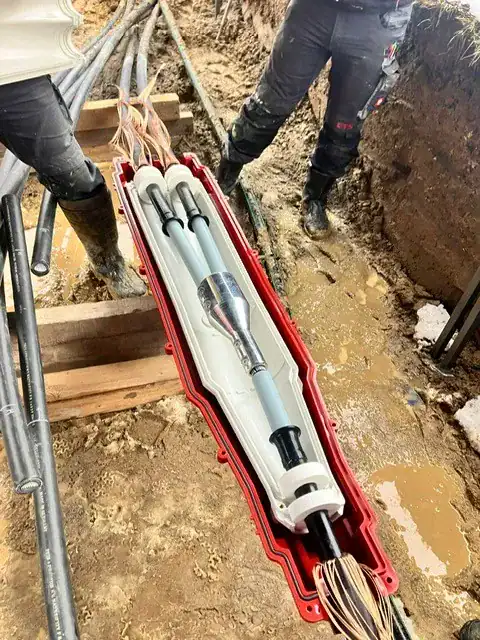
Feed‑in and branch joints for medium‑voltage networks in wind and solar parks
Wind and solar parks place different demands on medium‑voltage (MV) networks than traditional energy infrastructure. Power levels continue to increase, cable routes become longer, and network layouts grow more complex. At the same time, available space for underground infrastructure is often limited.
In addition, renewables make extensive use of inverters. As a result, MV networks are subjected to different loading conditions than in conventional grids. Harmonic effects therefore require additional attention. Together, these factors make the design of reliable MV connections increasingly important. Feed‑in and branch joints play a key role in this context.
Medium‑voltage networks in renewables: more complex than ever
Medium‑voltage networks in wind and solar parks are often designed as ring networks. This network structure allows power to be distributed via multiple routes and helps keep the network flexible during maintenance or modifications. At the same time, this type of network requires deliberate choices when expanding or adapting the infrastructure.
Typical challenges in renewable energy projects include:
- higher continuous loads
- longer cable routes
- limited space for additional cables and trenches
- harmonics caused by AC‑DC inverters
- high requirements for reliability and service life
In this context, the choice of the right medium‑voltage cable joint plays a decisive role in whether a network operates efficiently and remains future‑ready.
Feed‑in joints and branch joints: each with a distinct function
Within an MV network, feed‑in joints and branch joints each serve a specific purpose.
- A feed‑in joint is used to safely feed renewable energy from a wind or solar park back into an existing medium‑voltage network.
- A branch joint makes it possible to create additional connections within an existing cable route, without unnecessary cable extensions or extra trenching.
Both solutions are often combined within the same project, depending on the network design and the project phase.
LoviSil® feed‑in joints: reliable feed‑in within ring networks
Connecting a wind or solar park to the medium‑voltage network is a critical moment within a project. As long as the park is not connected, energy cannot be fed into the grid, which directly affects availability and revenue.
Lovink Enertech offers this solution through its LoviSil® feed‑in joints, developed specifically for feeding renewable energy into existing MV networks. These feed‑in joints are available for various cable configurations, including single‑core, three single‑core and three‑core medium‑voltage cables, making them widely applicable in wind and solar parks.
The design takes into account long‑term loading, ease of maintenance, and the impact of harmonics generated by inverters.
LoviSil® branch joints: efficient branching in limited space
In many renewable energy projects, space is a limiting factor. Installing additional cables or creating new routes quickly leads to higher costs and longer installation times.
Lovink Enertech offers this solution through its LoviSil® branch joints, developed to efficiently expand MV networks in renewables. By enabling branch connections directly within the existing cable route, networks remain compact and well‑organized.
Thanks to their modular design, these branch joints are suitable for multiple cable types and configurations, making them flexible solutions for network expansions, optimisations, and renovations.
Designed for long‑term reliability
Underground medium‑voltage connections are expected to operate reliably for decades. Failures are difficult to locate and have a direct impact on network availability and energy yield.
For this reason, feed‑in and branch joints for renewable applications are designed with a strong focus on:
- electrical stability under varying load conditions
- resistance to harmonic effects
- protection against moisture and external influences
LoviSil® technology is developed with these principles in mind and meets the demands of modern MV networks in renewable energy projects.
From generation to grid: making the right choices where it matters
Feed‑in and branch joints may represent a relatively small part of the overall energy system, but they have a significant impact on the performance of wind and solar parks. By making well‑considered choices at the design stage, MV networks remain reliable, efficient, and prepared for future expansion.
Interested in how feed‑in and branch joints can contribute to your renewable MV project?
Contact our specialists for expert advice on your medium‑voltage network.