Reliability in renewables: the role of installation
The energy transition requires reliable energy infrastructure that continues to perform under increasingly demanding conditions. This was also a central theme at Key Energy in Rimini, the leading trade fair for the energy transition, with a focus on sustainable energy solutions, innovation and networking.
During the event, we engaged in discussions with various parties from the renewables sector. The focus of these conversations was to gain a better understanding of the challenges involved in the installation and operation of energy infrastructure within wind and solar parks.
Attention for installation in practice
In many discussions, it became clear that within renewable energy projects the focus is often on generation technology and power electronics. Components within the medium‑voltage network generally receive less attention, even though this is where reliability is largely determined in practice.
Cable joints form a critical part of this infrastructure. In underground medium‑voltage networks of wind and solar parks, they are exposed to:
- high loads and frequent switching
- currents with a high harmonic content caused by inverters
- wet soils, coastal areas and varying environmental conditions
As also stated on the renewable energy application page, a single failed cable joint in an energy network can result in multiple turbines or part of a solar park going offline, with direct consequences for availability and energy yield.
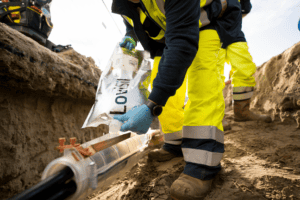
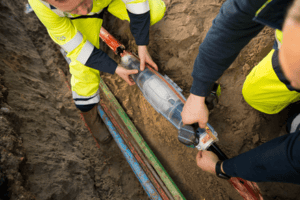
Installation simplicity and workmanship quality
Installation quality plays an important role in the reliability of medium‑voltage networks. Not only the design, but also the installation itself has a direct impact on the performance of cable connections in wind and solar parks.
Practical experience shows that a large share of cable joint failures is related to installation errors. This makes installation simplicity a relevant factor in reducing failure risks and maintenance costs.
Several factors play a role in this:
- a clear installation process with logical, easy‑to‑follow steps
- limited dependence on tools, such as burners
- proper training and knowledge transfer during installation
Technical challenges in renewable energy networks
Renewable energy networks are subject to specific loads. The use of power electronics introduces harmonics, which cause additional thermal and electrical stress in cable networks. Combined with long cable routes, large conductor cross‑sections and, in some cases, water‑saturated soils, this calls for solutions that are demonstrably designed for these conditions.
Within this market segment, Lovink focuses specifically on situations where these risks come together, including:
- networks with a high harmonic content
- projects in wet or coastal areas
- refurbishment and expansion of existing wind and solar parks
- situations where rapid commissioning is required
This focus aligns with what was discussed during the event: the need for connections that are not only technically sound, but also practically reliable within the reality of renewable energy projects.
From market insights to application
Key Energy made clear that reliability in renewable energy networks is not determined by a single factor. Installation simplicity, protection against environmental influences and performance under long‑term load all play an important role.
Learn more about cable joints for wind and solar parks and their role in medium‑voltage networks on the renewable energy application page.