Harmonics: The hidden challenge in renewable energy projects
The challenge: harmonics and partial discharge
Medium voltage (MV) power networks are changing rapidly. The increasing use of power electronics, such as photovoltaic inverters, EV chargers, wind turbines and modern industrial drives, has introduced harmonics and supraharmonics into the grid. More about challenges for joints for Renewable Energy can be found [here].
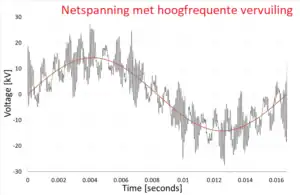
While traditional harmonic distortion has been managed for decades, higher‑frequency distortion (from 2 kHz up to 150 kHz) is now emerging as a new and underestimated risk. These so‑called supraharmonics interact with MV assets in ways that were not considered in original network designs.
For grid operators, this creates serious challenges:
- Increased electrical stress on insulation systems
- Accelerated partial discharge (PD) activity
- Faster aging of MV cables, joints and terminations
- Higher probability of unexpected failures and outages
What is the cause of harmonics in MV systems?
Harmonics and supraharmonics originate mainly from fast‑switching power electronic devices. Unlike classic low‑order harmonics, supraharmonics propagate differently through cables, transformers and joints, and can trigger local resonances in the network.
One of the most critical consequences is their interaction with partial discharge phenomena.
Research shows that:
- Supraharmonics can cause earlier PD inception
- They increase the number of PD events per second
- Combined electrical stress and local heating accelerate dielectric degradation
This effect is particularly severe in MV cable accessories, such as joints and terminations, where electric field stress is already high. Supraharmonic voltages and currents can significantly increase capacitive currents and local heating, creating conditions that may lead to catastrophic insulation failure.
In short, harmonics and supraharmonics do not just affect power quality — they directly threaten the reliability and lifetime of MV assets.
The solution: LoviSil® liquid silicone technology
LoviSil® is an innovative liquid silicone technology that eliminates these risks and significantly extends the life of cable connections. The advantages of LoviSil®:
- Partial Discharge: The liquid silicone is insensitive to partial discharge (PDs) due to its restorative properties.
- Geometric field control: Field control that is insensitive to harmonics so that no hotspots occur.
- Thermal stability: The Protolin® seal is resistant to extreme temperature changes and insensitive to thermal and chemical aging.
Why choose LoviSil® cable joints?
With LoviSil® we offer a proven solution for the most critical points in MV network of (renewable) energy projects. Our technology guarantees:
- Maximum reliability
- Long service life
- Lower maintenance costs
Want to know more about reliable cable connections?
Would you like to discover how LoviSil® MV cable joints protects your medium-voltage network against failures and saves costs? Feel free to contact our specialists for advice.