The Next Phase of the Energy Transition: Why Distribution Networks Need More Than Standard Solutions
Dennis Bergsma, Head of R&D at Lovink Enertech. In this article, he shares his professional perspective on the challenges facing modern distribution networks and the role of lifecycle-focused cable splicing solutions in supporting long-term network reliability.
The distribution network has become a critical asset
For many years, the energy transition was viewed primarily as a generation challenge. The focus was on building wind farms and solar farms while replacing fossil-fuel-based electricity with renewable generation. That phase remains important, but it is no longer the complete story. The next phase will be different. The real challenge is how to connect, transport, manage, and reliably distribute electrical power.
Across Europe and beyond, the same trend is becoming increasingly clear. Value is shifting from generation assets toward distribution networks, flexibility, energy storage, digitalization, reliability, and system integration. Utilities will need to connect more assets, operate networks closer to their limits, work with fewer skilled workers, and make better use of existing infrastructure.
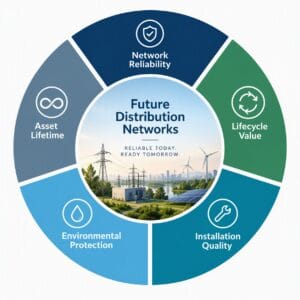
As a result, the role of medium-voltage cable accessories is changing. The future is not simply about installing more standard cable splices. It is about reducing failure risk, simplifying installation, protecting asset life, and creating lifecycle value in networks that are becoming more heavily loaded, more dynamic, and more critical.
Where standard solutions fall short
Standardization will remain essential. It provides consistency, repeatability, and a minimum level of confidence. However, compliance with standards alone will no longer be sufficient. The operating conditions utilities face today are revealing the limitations of existing standards.
For example, testing is performed using an ideal 50 Hz or 60 Hz power signal, while environmental factors such as heat waves are largely excluded from consideration. The key question is no longer: Does the splice pass the standard? The more important question is increasingly becoming: Will the splice continue to perform reliably throughout its required service life under actual field conditions?
Utilities, industrial customers, and contractors are therefore asking more complex questions. How can installation risks be reduced? How can premature failures be prevented? How can performance be maintained under thermal stress, moisture exposure, and aging? How can lifecycle costs be controlled?
These questions shift the discussion away from the lowest purchase price and toward long-term lifecycle value. A utility does not buy a cable splice simply because it needs a splice. It buys confidence: confidence in a reliable network, predictable performance, lower failure risk, and a service life that supports its asset management strategy.
This is where premium solutions become necessary. Not premium as a marketing label, but premium because the cost of failure, outage, replacement, and rework is significantly higher than the initial component cost. Operational uncertainty often carries a much greater price than the component itself.
System-Level Performance
Italy provides a clear example. In networks experiencing extremely high failure rates in medium-voltage splices, the issue is not merely the individual component. The real issue is lifecycle performance. Premature failures reduce asset life while increasing operating costs, outage risks, and replacement pressure.
If the failure mechanism is linked to environmental exposure, moisture, aging, or installation sensitivity, continuing to use traditional splice designs does not necessarily solve the problem.
Technologies such as liquid insulation and resin-based protection directly address these challenges, challenges that extend beyond the scope of existing standards. Liquid insulation supports long-term dielectric performance, while resin protection creates a robust barrier against moisture and environmental influences. The goal is not simply to pass a test, but to restore the cable splice system to its intended service life and lifecycle cost profile.
Germany demonstrates the same principle from a different perspective. High sheath currents caused traditional cable splices to overheat and fail prematurely, particularly in long-distance cables transporting electricity from wind farms. The root cause could not be solved by replacing one standard splice with another. By reducing sheath currents through a cross-bonding solution, the system could be returned to its expected service life.
The lesson is clear: future reliability often requires system-level thinking, not simply component replacement.
Moisture, heat, and aging: old problems in new forms
The primary enemy of underground cable systems has always been moisture ingress. Historically, discussions focused on high groundwater levels, flooded vaults, damaged outer protection, or improperly installed heat-shrink products.
Climate change is rapidly changing this context. Moisture and environmental stress now appear in more varied and demanding forms, including recurring flooding, waterlogged conditions, summer heat waves, winter freeze-thaw cycles, elevated soil temperatures, and accelerated material aging.
Italy has demonstrated how heat and environmental conditions can become major factors in network reliability. Similar concerns are appearing in regions exposed to extreme temperatures, including parts of the United States. Heat waves, dry soil conditions, and water ingress do not act independently. Together, they accelerate stress on underground cable accessories.
Proven resin-based technology therefore remains highly relevant. It is not a fashionable solution. It is a durable one. By supporting long-term performance under real-world field conditions, robust resin protection systems provide a stable barrier against moisture and environmental exposure.
From Component Supplier to Lifecycle Partner
Failure investigations involving heat-shrink medium-voltage splices often reveal familiar root causes: installation or positioning errors, material damage during installation, degradation caused by aging, overheating, or environmental exposure.
The pattern is important. Many failures are not caused by a single factor. Instead, they result from the interaction between product design, installation practices, material behavior, thermal loading, and environmental conditions.
The value of next-generation cable accessories will no longer come solely from the physical connection itself. Value will increasingly result from the combination of product performance, installation quality, diagnostics, field experience, and lifecycle support.
For utilities, industrial customers, and contractors, the better question is no longer: What is the lowest-cost splice? The better question is: Which solution will protect the network throughout its required service life?
This creates opportunities for premium lifecycle-focused solutions, including installation-tolerant splice systems, robust insulation and sealing technologies, cross-bonding and system-level current management, splicer training, failure analysis, diagnostic support, and lifecycle advisory services.
The future will reward lifecycle value
The next decade will not be defined by those who manufacture the lowest-cost standard component. It will be defined by those who help build, operate, and maintain reliable and increasingly complex distribution networks.
The conclusion is clear: the future value of cable accessories will increasingly depend on their contribution to network utilization, reliability, and lifecycle value, not simply on whether they meet today’s minimum standards.
The energy transition is entering a new phase. The winners will not only be those who generate renewable electricity. They will also be those who enable distribution networks to connect, manage, and reliably deliver that power where it is needed most.