The Next Phase of the Energy Transition: Why Distribution Networks Need More Than Standard Solutions
Dennis Bergsma, Head of R&D at Lovink Enertech. In this article, he shares his professional perspective on the challenges facing modern distribution networks and the role of lifecycle-focused cable jointing solutions in supporting long-term network reliability.
The distribution network has become the critical asset
For many years, the energy transition was mainly seen as a generational challenge. The focus was mainly on building wind farms, solar parks and replacing fossil with renewable electricity. This phase is still important, but it is no longer the complete story. The next phase will be different: the real challenge is how to connect, transport, manage and reliably distribute electrical power.
Across Europe and beyond, the same pattern is becoming more and more clear. The value is shifting from generational assets towards distribution grids, flexibility, storage, digitalisation, reliability and system integration. Grid operators will need to connect more assets, operate networks closer to their limits, work with fewer skilled people and will have to make better use of existing infrastructure.
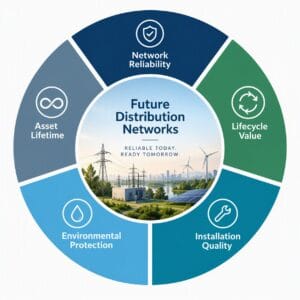
The medium-voltage cable accessories roll will therefore be changed. The future simply is not about installing more standard cable joints. It is about reducing failure risk, reducing installation burdens, protecting the asset lifetime and creating a lifecycle value in networks, that will become more heavily loaded, more dynamic and more critical.
Where standard solutions fall short
Standardisation will remain essential. It provides clarity, repeatability and will ensure a minimum level of confidence. But standard compliance alone will not be enough. The operating conditions that are currently observed are revealing the shortcomings of current standards. For example, testing is performed with a perfect 50 or 60 Hz signal but the environmental factors, such as heat waves, are disregarded. The relevant question is no longer: does the joint pass the standard? The more important question is increasingly becoming: will the joint continue to perform reliably for the required service life under the real field conditions?
Grid operators, industrial customers and contractors are therefore asking more complex questions. How will the installation risks be reduced? How will premature failures be avoided? How will performance be maintained under thermal stress, moisture and ageing? How lifecycle costs are controlled?
These questions give another perspective to the discussion of a lowest purchase price towards a reliable lifecycle value. A grid operator does simply not buy a cable joint because it needs a joint, they buy more confidence: a reliable network, predictable performance, lower failure risk and service life that matches the asset strategy. This is where premium solutions become necessary: not premium as a label, but premium because failure’s costs, outage, replacement and rework. So the operational uncertainty is much higher than the initial component price.
System-level performance
Italy provides us with a clear example. In networks facing extremely high failure rates in medium-voltage joints, the issue is not merely the individual component. The real issue is lifecycle performance: premature failures will reduce useful life and will increase operational cost, outage risk and replacement pressure. If the failure mechanism is linked to environmental exposure, moisture, ageing or installation sensitivity, continuing with traditional standard joint concepts does not necessarily solve this problem.
Technologies like liquid insulation and resin protection precisely addresses this type of challenge, challenges that go beyond the standards. The liquid insulation supports a long-term dielectric performance, while the resin protection creates a robust barrier against moisture and environmental influences. The objective is not simply to pass the test, but to restore the cable joint system to the necessary service life and the associated lifecycle cost level.
Germany shows the same principle from another angle. Due to high sheath currents traditional cable joints suffered from overheating and premature failure, especially in a long-distance network distributing power from a wind farms. The root cause will not be solved by replacing one standard joint with another. To reduce the high sheath currents by applying cross-bonding solution, the system could be brought back towards the expected service life. The lesson is very clear: future reliability requires often system thinking, not simply by component replacement.
Moisture, heat and ageing: old problems in a new form
The main enemy of underground cable systems has always been moisture ingress. Historically, the discussion focussed on high water tables, flooded manholes, damaged outer protection or incorrectly applied shrink technologies. Climate change is rapidly changing this context. Now moisture and environmental stress appear in a more diverse and demanding form: repeated flooding, floating water conditions, summer or winter heatwaves, high ground temperatures and accelerated material ageing.
Italy has shown how heat- and environmental conditions can become a major part of the reliability discussion. Similar concerns are visible in regions exposed to extreme heat, such as parts of the United States. Heatwaves, dry soil conditions and water ingress do not act separately. Together, they accelerate stress on underground cable accessories.
Proven resin-based technology remains highly relevant. It is not a fashionable solution, but it is a timeless one. While supporting long-term performance in real field conditions, a robust resin protection system provides a stable barrier against moisture and environmental exposure.
From component supplier to lifecycle partner
Failure investigations on shrink-based medium-voltage joints often point towards familiar root causes. Assembly or positioning errors, material damage resulting from installation, breakdown due to material ageing, overheating or environmental exposure. The pattern is important. Many failures are not caused by one single factor only. They result from the interaction between product design, installation practice, material behaviour, thermal loading and environmental conditions.
The value of the next generation accessories will not solely stem from the physical connection. The value will come from the combination of product performance, installation quality, diagnostics, field knowledge and lifecycle support.
For grid operators, industrial customers and contractors, the better question will not be: what is the cheapest joint? The better question will be: which solution will protect the network over its required service life? This will create opportunities for premium lifecycle-based solutions: for example, installation-tolerant joint systems, robust insulation and sealing concepts, cross-bonding and system-level current management, jointer training, failure analysis, diagnostic support and lifecycle advisory services.
The future will reward a lifecycle value
The next decade will not be defined by those who will manufacture the lowest-cost standard component. It will be defined by those who will contribute to build, operate and maintain reliable complex distribution networks.
The conclusion is clear: the cable accessories’ future value will increasingly depend on its contribution to network utilisation, reliability and its expected lifecycle value — so not only on whether it will meet today’s minimum standard.
The energy transition will enter a new phase. The winners will not only be those who will generate renewable energy. But will be those who will enable distribution networks to connect, manage and reliably use.